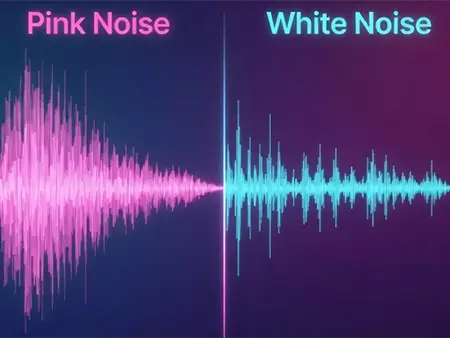
Both pink and white noise are broadband sounds containing all audible frequencies (roughly 20 Hz to 20,000 Hz), but they differ in how energy is distributed across those frequencies.
White Noise
- Equal power (energy) per frequency interval—flat power spectral density.
- Analogy: Like white light, containing all colors at equal intensity.
- Sounds harsh or hissy (e.g., TV static, radio hiss) due to stronger high frequencies.
- Power decreases by 0 dB per octave.
Pink Noise (also called 1/f noise)
- Power spectral density inversely proportional to frequency (proportional to 1/f).
- Equal power per octave (halving/doubling frequency bands).
- Power decreases by 3 dB per octave (or ~10 dB per decade).
- Sounds deeper, warmer, and more natural (e.g., steady rain, wind, waterfall) because lower frequencies are emphasized and higher ones are attenuated.
- Common in nature and many physical systems (e.g., heartbeats, river flow).
This 1/f distribution makes pink noise feel more balanced to human hearing, as our ears perceive octaves logarithmically.
Applications and Benefits (Supported by Studies)
Sound Masking and Tinnitus Relief
- Both are used for masking tinnitus (ringing in ears) by providing background sound to distract from or cover the perceived tone.
- Studies show both white and pink noise reduce tinnitus discomfort effectively, with no significant difference in outcomes between them.
- Patient preference varies: Many prefer white noise for better high-frequency masking, while others find pink noise gentler and less irritating long-term (as white can sometimes exacerbate symptoms due to harsh highs).
- One study suggested pink noise may be particularly helpful for mid/low-frequency tinnitus due to its energy distribution.
Sleep and Relaxation
- Pink noise often outperforms white for sleep: It enhances deep (slow-wave) sleep, synchronizes brain waves, and may improve memory consolidation.
- White noise is great for blocking sudden noises (e.g., traffic) but can feel abrasive.
- Pink's natural, soothing quality promotes relaxation and longer sleep duration in some research.
In summary, white noise is "flat and bright," ideal for pure masking, while pink noise is "deeper and natural," often preferred for comfort, extended listening, and potential cognitive/sleep benefits.
In our tinnitus masking library we also offer a combination of both a smooth bed of relaxing pink noise, with a focused frequency of white noise added to target your tinnitus but also feel destracted by the gentle phasing also added to the underlying pink noise.
